Book-Bat

Book-Bat

Exploring the world of fantasy from a Christian perspective!

  • Home
  • About Us
  • Podcast
  • books
    • all books
    • Nonfiction
    • For Kids Ages 9-12
    • Xenofiction
  • Blog
  • More
    • Christian Perspective
    • Book Reviews
    • Connect
    • Events

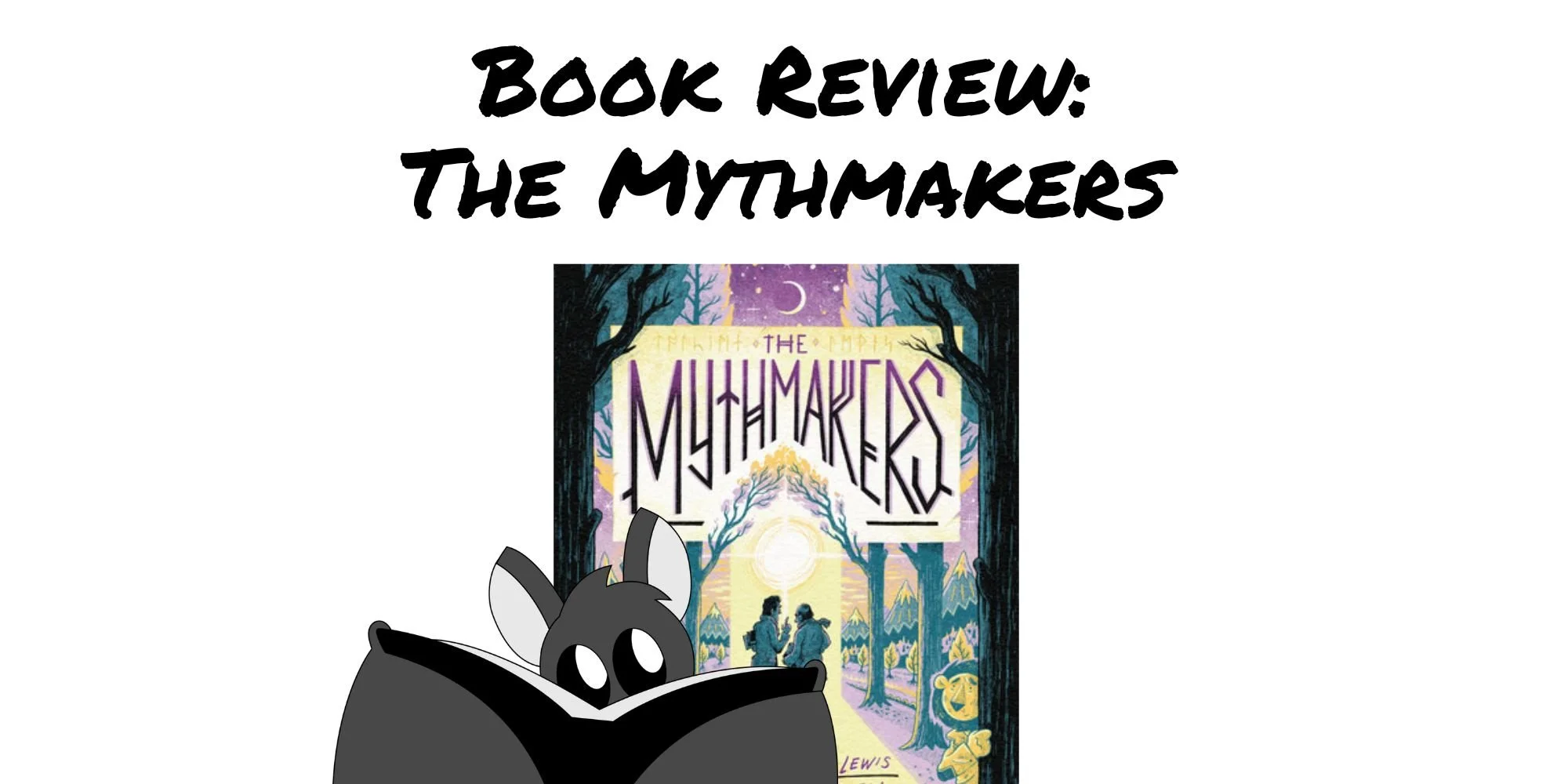
Book Review: The Mythmakers

January 07, 2026 by Karlissa Koop in Book Reviews, Designs and Art, Reading and Writing

In the latter stages of my research for To Narnia and Beyond, I encountered frequent praise for The Mythmakers: The Remarkable Fellowship of C. S. Lewis and J. R. R. Tolkien. Created by illustrator and writer John Hendrix, and released in 2024, the book meshes elements of graphic novel with illustrations-alongside-prose.

Eventually, I was convinced to buy the book and stepped into Hendrix’s immersive biography of Lewis and Tolkien. Following their lives from birth to death, The Mythmakers gives special attention to their friendship and years shared together. Imaginative narration from a lion and a wizard guides the reader in a fun and informative manner, giving playful context to bunny trails – “Portals” as the book calls them – about the nature of myth and the fantasy genre.

Beautiful, well-researched and poignant, the visuals of The Mythmakers give greater weight and context to the experiences of Lewis and Tolkien. I find it particularly useful for thinking about their time in World War I, where pictures can convey a heaviness that words struggle to speak of.

Whether you are researching Lewis and Tolkien or simply passionate about fantasy and history, I highly recommend this lovingly crafted book. The price tag is a little higher, as it comes in hardcover and full-colour: there is no paperback or black-ink-only edition to provide a cheaper entry point. However, the cost isn’t unreasonable, and I found it well worth the price.

If you’re interested in learning more about the works of C.S. Lewis and J.R.R. Tolkien, you may enjoy my upcoming book, To Narnia and Beyond: Four Christians Who Used Fantasy to Teach Spiritual Truths. Click on the image below to learn more!
January 07, 2026 /Karlissa Koop
The Mythmakers, John Hendrix, book review, books, fantasy genre, fantasy history, Christian fantasy, Chronicles of Narnia, The Lord of the Rings, CS Lewis, JRR Tolkien, classic authors, biography, literary
Book Reviews, Designs and Art, Reading and Writing
Comment

Is It Time You Read Out of the Silent Planet?

November 29, 2025 by Karlissa Koop in Thoughts on Fantasy, Fantasy Review, Book Reviews

By Karlissa J

Have you read C.S. Lewis’ Cosmic Trilogy?

You may or may not be aware, but today – November 29 – is C.S. Lewis Reading Day.

Clive Staples Lewis has served as an entry point to fantasy for many Christian readers. He is also well-respected for his spiritual teaching. But before he ever wrote The Chronicles of Narnia or Mere Christianity, C.S. Lewis pursued the creation of a trilogy in a genre that thrilled him: science fiction. The first book of the trilogy, Out of the Silent Planet, was released in 1938.

Out of the Silent Planet introduces Ransom, a man who finds himself kidnapped and taken on a journey through space to another planet. He escapes his kidnappers and wanders the planet’s wilderness until he encounters a native. Ransom befriends the alien being, and from there, his understanding of the world gradually grows.

I have to admit, this is my kind of story! Exploring an enchanting world, interacting with non-human creatures, and discovering a new language and culture!

Appropriately (or perhaps conveniently), Ransom is a philologist (someone who studies language differences); this provides an excuse for the language barrier to be rather smoothly crossed, and an excuse for Lewis to fixate on unique words and concepts.

Perhaps the lesser fame of this work is, in part, due to the fact that it's not for kids: unlike Narnia, it contains a spattering of mature content, nudity, and mild swearing; nothing obscene, but some Christian readers may find it unexpected. Especially those who assume that Lewis’ fantasy stories were all written for children.

However, if you love fantasy and sci-fi, and want to read more from Lewis, I recommend you pick up Out of the Silent Planet!

Also, if you’re interested in learning more about fantasy novels from Christian authors like C.S. Lewis, you may enjoy my upcoming book, To Narnia and Beyond: Four Christians Who Used Fantasy to Teach Spiritual Truths. You can learn more about it by clicking on the image below!

November 29, 2025 /Karlissa Koop
classics, CS Lewis, sci-fi, books, book review, classic authors, Out of the Silent Planet, Ransom Trilogy, Cosmic Trilogy, Space Trilogy
Thoughts on Fantasy, Fantasy Review, Book Reviews
Comment

Four Approaches to Writing Christian Fantasy

June 02, 2025 by Karlissa Koop in Reading and Writing

By Karlissa J

“If a writer’s aim be logical conviction, he must spare no logical pains… where his object is to move by suggestion, to cause to imagine… If there be music in my reader, I would gladly wake it.” George MacDonald, “The Fantastic Imagination”


Many people debate over whether The Lord of the Rings should be called a “Christian” book series. Tolkien himself once said his books were religious, but different people have different standards for applying the label “Christian” to a work of art; and The Lord of the Rings is subtle in its use of spiritual themes.

For some readers, the subtlety leaves them more open to learning from the books, and the lessons go deeper. Other readers, however, walk away unsure whether they learned anything, and completely unaware of Tolkien’s Christian faith.

Contrast that with the style of George MacDonald. MacDonald was a preacher, and when he told stories he didn’t stop preaching. His fantasy books and fairytales were also deeply symbolic, so in addition to surface-level teachings there are layers to discover upon rereading.

For some (like Lewis) this makes MacDonald’s fantasies rich, exciting, and memorable. Tolkien, however, came to resent them as being too preachy; and some modern readers will find MacDonald’s florid narrative style and layered symbolism hard to make sense of.

L'Engle’s Time Quartet books are an odd mix of openly Christian and bizarrely unconventional. Some readers are deeply moved and drawn to Jesus by these stories, while other readers come away critiquing her beliefs as unorthodox.

And then there’s Lewis. His Cosmic Trilogy alone is all over the place, from only subtly Christian (Out of the Silent Planet) to deeply theological (Perelandra) to focused on critiquing a particular philosophy (That Hideous Strength). His preachiness varies accordingly.

Which is better: to openly declare a Christian message? To subtly explore a Christian worldview in a tale of good versus evil? To fill a story with much teaching and instruction?

I believe all have their place, because there are a myriad of readers in different stages of their walk with God, coming from a variety of backgrounds, ages, reading skills, and learning styles.

In response to a question about how to include Christian messages in a fantasy book, current fantasy author Wayne Thomas Batson had this to say:

“Your allegory will always be too obvious for some and not enough for others. The big thing is, always respect the story itself. If the message within the allegory is precious and valuable, but the story built around it is superficial, it will fail. Tell a fantastic and meaningful story; respect the genre and the reader, and any allegory within will be that much more powerful.” {See Note}

Each of these four classic authors – George MacDonald, J.R.R. Tolkien, C.S. Lewis, and Madeleine L’Engle – had a different way of telling a fantasy story. I encourage you to try reading a book from all of them! Find out which author or authors you enjoy most and learn from best.


NOTE: quote from GoodReads author page for Wayne Thomas Batson: https://www.goodreads.com/author/33508.Wayne_Thomas_Batson/questions (accessed August 27, 2024)

June 02, 2025 /Karlissa Koop
Christian fantasy, classics, classic authors, CS Lewis, JRR Tolkien, George MacDonald, Madeleine L'Engle, writing, tips
Reading and Writing
Comment

Powered by Squarespace