Book-Bat

Book-Bat

Exploring the world of fantasy from a Christian perspective!

  • Home
  • About Us
  • books
    • all books
    • Nonfiction
    • For Kids Ages 9-12
    • Xenofiction
  • Podcast
  • Blog
  • More
    • Book Reviews
    • Connect
    • Events

How Spy x Family Helps My Marriage

November 03, 2025 by Karlissa Koop in Book Reviews, Fantasy Review, Thoughts on Life, Thoughts on Fantasy

By Jason Koop

Let’s get this out of the way, I grew up in a western Evangelical culture.  As such, I was exposed to a lot of the common tropes in the 90s and 00s.  And with the goggles of retrospection on, I can only now start to recognize the waters I was swimming in.

One thing that was abundantly clear:  Fantasy was not for “good, Christian adults”!  It was only something for kids/teens to grow out of once they got older and “more mature”.  A placeholder, not something to hold onto into adulthood – unless you were using it to teach something to children or young teens.

Fantasy… For Grown-Up Christians?


Why, the very idea that any credible adult could have any positive, growing experience from reading stories about a blue hedgehog that runs at super-sonic speeds, spandex and caped crusaders fighting outsized villainy, or a hero with an ancient sword who smashes pottery to find gems?

Preposterous!  Utterly ridiculous!  Up surd!  No, no, no, NO!!!  Real, mature Christian adults can only be instructed with self-help adjacent, study type books.  Everyone knows that!

Well… okay, but why?  Do we lose something as we get older and need everything spelled out for us in order for it to sink in?  And why is it that a freakish number of these “lessons” imparted through many of these “study group” books are ever so quickly forgotten and never fondly remembered?

This year, Karlissa and I are celebrating our tenth anniversary.  And I’m sure it would come as no great surprise to anyone to find out that we have clashed; and still do.  As someone who grew up in Western Evangelical culture – but never really knew the waters I was swimming in – I am surprised at how easily I came up with the expected steps when our relationship struggles.

·         Talk to a pastor/church elder

·         Read a Christian marriage book

·         Listen to Christian marriage “experts” – podcasts, YouTube videos, TikTok, FaceBook, etc.

None of these are particularly appealing to me for a variety of reasons.  Being an introvert. Finding most “Christian” marriage advice to be pretty shallow and mostly a band-aid solution.

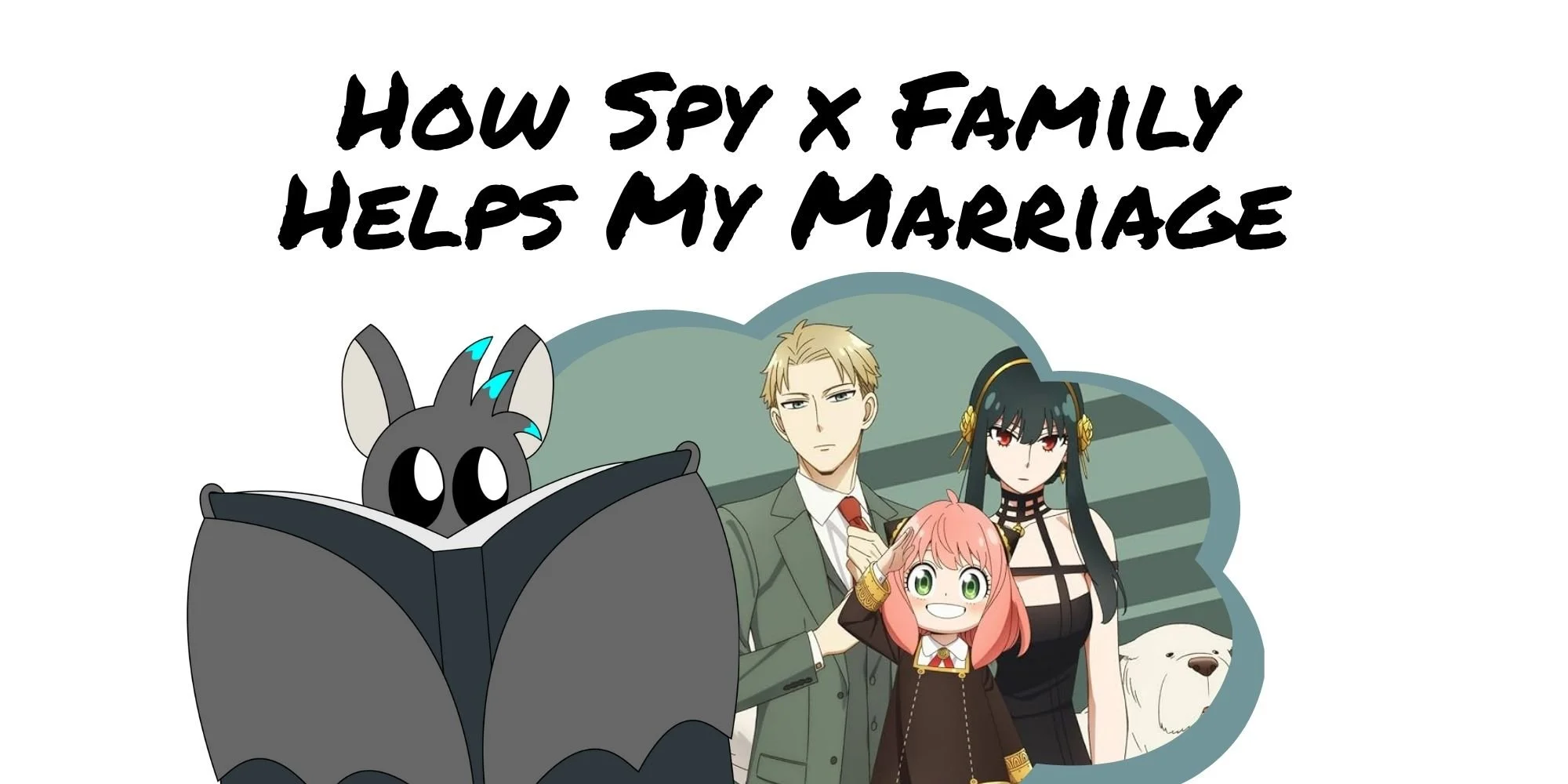
But then, I came across something that not only grabbed my attention, but has begun to transform how I see not only my marriage, but my whole family.  Spy x Family.

Not Your Average Spy Story


Written and drawn by Tatsuya Endo, this ongoing manga debuted in 2019.  And, despite Endo having been in the manga game since the year 2000, this was his first work to be published in English.  The premise is as follows…

In a Cold War-esque setting, a spy – code named “Twilight” – is tasked with getting close to reclusive politician Donovan Desmond to hopefully prevent a nuclear war between rival nations Westalis and Ostania.  However, the only way to do so is through his son Damian, and the best way to do so is through the private school that Damian attends.

Therefore, Twilight is tasked with creating his own “family”.  In turn he adopts little girl Anya and marries Yor to be his daughter and wife, respectively.  However, he keeps them all in the dark that he is a spy on a mission. 

Unbeknownst to him, though, both Anya and Yor are keeping secrets from him as well.  Anya is a telepath, and Yor is an assassin.  And thus, all three are trying to play the part of a happy family while keeping significant secrets from each other.

Okay, I know this sounds completely ridiculous.  But really, I think it is all a front for addressing real family life and struggles.

Twilight (going by Loid Forger), is very much a dad.  Equal parts composed, family leader, overworked and worrying that he isn’t doing well as a husband or father – thus compromising his cover – and I find him so relatable.  He works hard, tries to make Anya study to do well in school, and constantly tries to affirm and encourage Yor as a wife, mother and person.

Yor is equal parts deadly competent and completely clueless.  On one hand, her strength, love and resolve enabled her to raise her brother (Yuri) when they were children and has made her into a pillar of comfort and safety to Anya.  On the other hand, her complete lack of cooking skills and social competence often leaves her on the wrong side of cultural expectations.

Anya is childishly naïve, yet somehow more in touch with things than either of her parents.  Because of her telepathy, she not only knows both of their secrets, but picks up on struggles that both try to keep hidden from her.  And yet, she is constantly afraid that if everyone knew each others’ secrets, it would destroy this family and the stability that she desperately needs.

And the story plays this out so superbly.  Amid all the espionage, assassinations, and classroom drama is a family that is trying to find out how to function as a unit, despite their differences and secrets they can’t/won’t tell each other.

Lessons Learned


Now, how has this helped me in my marriage and family life?  This all seems a little too outlandish, you might say, to be even remotely helpful.  However, in this story I have been shown things that stick with me much more than simply being told “do this/do that”.  Lessons like:

·         What sticks with the child is family experiences much more than nice toys/presents

·         While adults aren’t culturally allowed to ask for affirmation, they still need it

·         While we are individuals, we are at our best when we sacrifice for others

·         Miscommunication happens, but it needs to be worked through

·         Raising a healthy child is much more involved than simply checking of a list of needs

And these are all told through entertaining and wildly unrealistic stories that ensure that the lessons will likely linger with me that much longer.

Maybe all of this means that I am not a proper, mature, Christian adult.  But I would like to think that stories like Spy x Family that can teach us something, perhaps in an unexpected way, that will then stay with us much longer than a lecture or spiritualized self-help book.

November 03, 2025 /Karlissa Koop
Spy x Family, storytelling, marriage, media musings, anime, manga
Book Reviews, Fantasy Review, Thoughts on Life, Thoughts on Fantasy
Comment

Is Art Subjective?

August 02, 2025 by Karlissa Koop in Thoughts on Fantasy, Thoughts on Life, Reading and Writing

By Jason Koop

“Art is subjective”. 

That’s a line most of us have heard, in one form or another, in our lifetime.  Put that line into a Google search, and you will get many people’s (and AI’s) take on it. 

My thoughts on that line have run the gamut from “What does that even mean?” to “That’s your excuse for defending something that is just bad” to me using it to defend my own preferences.

For the sake of this post, I’m not coming at the line “art is subjective” from the perspective that there is no “good” or “bad” art, because “beauty is in the eye of the beholder”. And I’m not saying I can convince you that some piece of art is “good” or “bad” because of how it grades on a specific formula.  I’m going to approach the line “Art is subjective” from the mindset that a piece of art can mean different things to different people at different times.

Basically, to appropriate Shrek’s greatest line:  Art is like onions.

What brought this on is two videos I saw on YouTube that discussed two franchises/series I have some definite thoughts about.  The first was The Dark Underlying Theme of IDW Sonic by Sonic Theory, and the other was The Chronicles of Narnia: The Black Sheep of 2000’s Fantasy by The Thrifty Typewriter.

In The Dark Underlying Theme of IDW Sonic, Sonic Theory argues that a major theme in the IDW Sonic comic books is free will. And I must say, having read the comics I didn’t make that connection, but then again, you’re talking about the guy who didn’t know Hamlet was contemplating suicide when he says “to be or not to be”, so… there’s that.  Sonic Theory has a point.  The theme of free will isn’t slammed in the audience’s face in a way that you cannot miss it, but now having had it pointed out, I can’t stop seeing it.  I honestly want to do a deep dive on that theme using all the characters (yes, I’m a Sonic nerd, where have you been?).

The Chronicles of Narnia: The Black Sheep of 2000’s Fantasy looks at the three theatrical movies that came out in 2005, 2008 and 2010 (The Lion, The Witch, And The Wardrobe; Prince Caspian; The Voyage of the Dawn Treader) and how they fit into the fantasy saturation that really kicked off in the 2000s.  Comparing the films to the contemporaries of their time gives the review an interesting angle.  While I don’t really agree with The Thrifty Typewriter’s takes, frankly it has more to do with the fact that I have at least a basic grasp of the spiritual tones of the stories and he doesn’t.  His perspective is drawn from taking into account the media landscape the movies were being released into.

These two seemingly unrelated things do in fact share a common thread I’d like to tug on.  They showcase how an underrated determiner of what the audience’s takeaway(s) of a story/character is the individual’s perspective.  My main takeaways from the Sonic the Hedgehog IDW comics are the themes of friendship and teamwork.  I tend to see The Chronicles of Narnia movies by comparing them to the books and the Christian themes that C.S. Lewis tried to get across. But these YouTube reviewers saw different things, probably based on their own perspectives and life experiences.

“Art is subjective”.  I used to balk at the very idea of it.  If you had a differing take on a book/movie/video game, well then you were just wrong.  And if you were to imply that there were multiple different themes that could be taken from said media, depending on how you approached it, well that was just plain silly.  The themes are the themes, and they are plainly universal, regardless of your perspective.

But now… I wonder if the themes one takes away from a piece of art are indeed subjective, because of our human flaws and brokenness.  Perhaps we are incapable of perfectly getting across themes and stories, which then leaves cracks where the audience can fill in with their own personal life experience and theology.

And by God’s grace, He makes it so that imperfect stories told by imperfect humans can have a richness of meaning.  Maybe even beyond what the creator intended.

August 02, 2025 /Karlissa Koop
art, perspective, themes, Sonic the Hedgehog, Chronicles of Narnia, storytelling
Thoughts on Fantasy, Thoughts on Life, Reading and Writing
Comment

Powered by Squarespace