Book-Bat

Book-Bat

Exploring the world of fantasy from a Christian perspective!

  • Home
  • About Us
  • books
    • all books
    • Nonfiction
    • Middle Grade Fantasy
    • Tales of the Diversity
  • Podcast
  • Blog
  • Library
  • Events
  • More
    • Christian Perspective
    • Connect

Behind-the-Scenes: Writing about C.S. Lewis and the Bible

May 06, 2026 by Karlissa Koop in Classic Novels & Authors, Author Insights

By Karlissa J

While I was writing To Narnia and Beyond, I ‘tried out’ a variety of content and information that ultimately didn’t make it into the book. At one point, I had a chapter comparing how the four authors – MacDonald, Tolkien, Lewis, and L’Engle – each interacted with the Bible in their storytelling. Here is part of the section that I wrote for C.S. Lewis.

The Lion, the Witch and the Wardrobe was the first of the Narnia books written by C.S. Lewis, and it has been highly regarded for how it poignantly mirrors the death and resurrection story of Jesus.

Though there are other events going on in the tale, at the core of the story is the lion Aslan allowing himself to be bound to the stone table in place of the traitor Edmund, where Aslan dies and then, gloriously, is raised back to life. The story’s connections to the Gospels have been obvious to many (though not all) readers.

However, most of Lewis’ fantasy books aren’t based around Bible stories. In fact, many of Lewis’ works barely seem to mention scripture.

In his books of theology and apologetics, Lewis emphasized the importance of using both our logical capacities and our imaginative capacities to explore our faith. He defended traditional Christian beliefs against those who considered them outdated. And he meditated on the nature of God.

C.S. Lewis was a part of the Anglican church, which is a liturgical-style church where there is regular reading of the scriptures and quotes from the Bible within the service. In the Anglican church I attend, every Sunday there is a reading from the Old Testament, a Psalm is recited as a congregation, there’s a reading from the Epistles or Revelation, and there’s a reading from the Gospels (in addition to sometimes reciting parts of Isaiah or other Bible passages). Though his services may have looked slightly different, Lewis would have been very accustomed to hearing multiple portions of scripture in church.

But despite all of this, Lewis rarely mentioned the Bible in any of his writings. He wrote over twenty books, many of them nonfiction works aimed at Christian instruction, yet his only Bible study book was A Reflection on the Psalms.

In the C.S. Lewis Podcast, Lewis biographer Alister McGrath contemplates this.

“Lewis actually doesn’t look at the Bible all that much,” he notes. Instead, “he more looks along it, or he looks at people who have looked along it, and asks, what is this telling me about myself, the way the world is? Lewis I think is using the Bible, but not perhaps in the way you might expect.” (Note 1.)

Sometimes fantasy authors choose to retell Bible stories. Sometimes they choose to quote passages of scripture. And sometimes, the Bible’s influence on their writings is more subtle, existing as the behind-the-scenes source that helped the author pinpoint who God is and how He interacts with His world.

Since coming up with this now-discarded content, I’ve learned that C.S. Lewis might have had a more complex relationship with the Bible than I ever knew. That is one interesting aspect of research: discovering the depth and nuance in life, and how much you didn’t know! But for now, I’m busy reading xenofiction novels - so I may have to revisit Lewis’ understanding of the Bible some other time…


Note 1: The C.S. Lewis Podcast, “#52 Reflections on the Psalms” (posted May 2, 2022).
 

Subscribe to the Book-Bat newsletter!

* indicates required
/* real people should not fill this in and expect good things - do not remove this or risk form bot signups */

Intuit Mailchimp

May 06, 2026 /Karlissa Koop
CS Lewis, classics, classic authors, Chronicles of Narnia, Christian fantasy, Christianity, Bible, behind the scenes
Classic Novels & Authors, Author Insights
Comment

Behind-the-Scenes: Why I Included L'Engle in To Narnia and Beyond

February 04, 2026 by Karlissa Koop in Sneak Peaks, Classic Novels & Authors, Author Insights

By Karlissa J


At one point in my writing of To Narnia and Beyond, I was planning not to include Madeleine L’Engle.

I was still in the process of narrowing down which authors to focus on in my exploration of classic Christian fantasy. I’d decided that only deceased authors would count, as I wanted there to have been enough time to see how their legacy endured beyond them. Three authors were very obviously getting in: everyone knows of J.R.R. Tolkien and C.S. Lewis as pillars of fantasy; and George MacDonald had such a strong impact on Lewis (and on me) that there was no denying his inclusion as well.

But what about Madeleine L’Engle?

She is more recent than the other three: Lewis was the youngest of those men, and she was born on his 20th birthday. Her death occurred in 2007, not quite two decades ago. Her Time Quartet novels are odd, falling somewhere between fantasy and sci-fi. And I found that many readers I spoke to had never heard of her.

So why did I end up featuring her in my book To Narnia and Beyond?

For one, she didn’t stop coming up. It was important to me that each of the authors I included inspired Christians beyond their own generation. What I discovered in L’Engle was that she did just that. One of the people she inspired was painter Makoto Fujimura, whose books on faith and art I have greatly enjoyed. I realised that, even if fewer people have heard of her than Lewis or Tolkien, she has left a creative legacy that continues to inspire.

Second, I couldn’t deny anymore the way her writings had changed me.

Initially, I thought her books were strange. But I found myself contemplating life and my thoughts came to a story she’d told. What does it mean to love your enemy? What does it look like for each creature to submit to being what God called them to be? My children have asked me about baby unicorns, and I’m sure they come from eggs, because L’Engle’s A Swiftly Tilting Planet told me so.

Since I’ve written about her in my book, I have encountered more readers who know of Madeleine L’Engle and have enjoyed her writing. I expect that as I continue to talk to people about classic fantasy novels, I’ll continue to meet those who have been inspired by her.

 
February 04, 2026 /Karlissa Koop
Madeleine L'Engle, To Narnia and Beyond, classics, classic authors, Christian fantasy, faith, behind the scenes, hatching unicorns
Sneak Peaks, Classic Novels & Authors, Author Insights
Comment

Book Review: The Mythmakers

January 07, 2026 by Karlissa Koop in Book Reviews, Designs and Art, Classic Novels & Authors

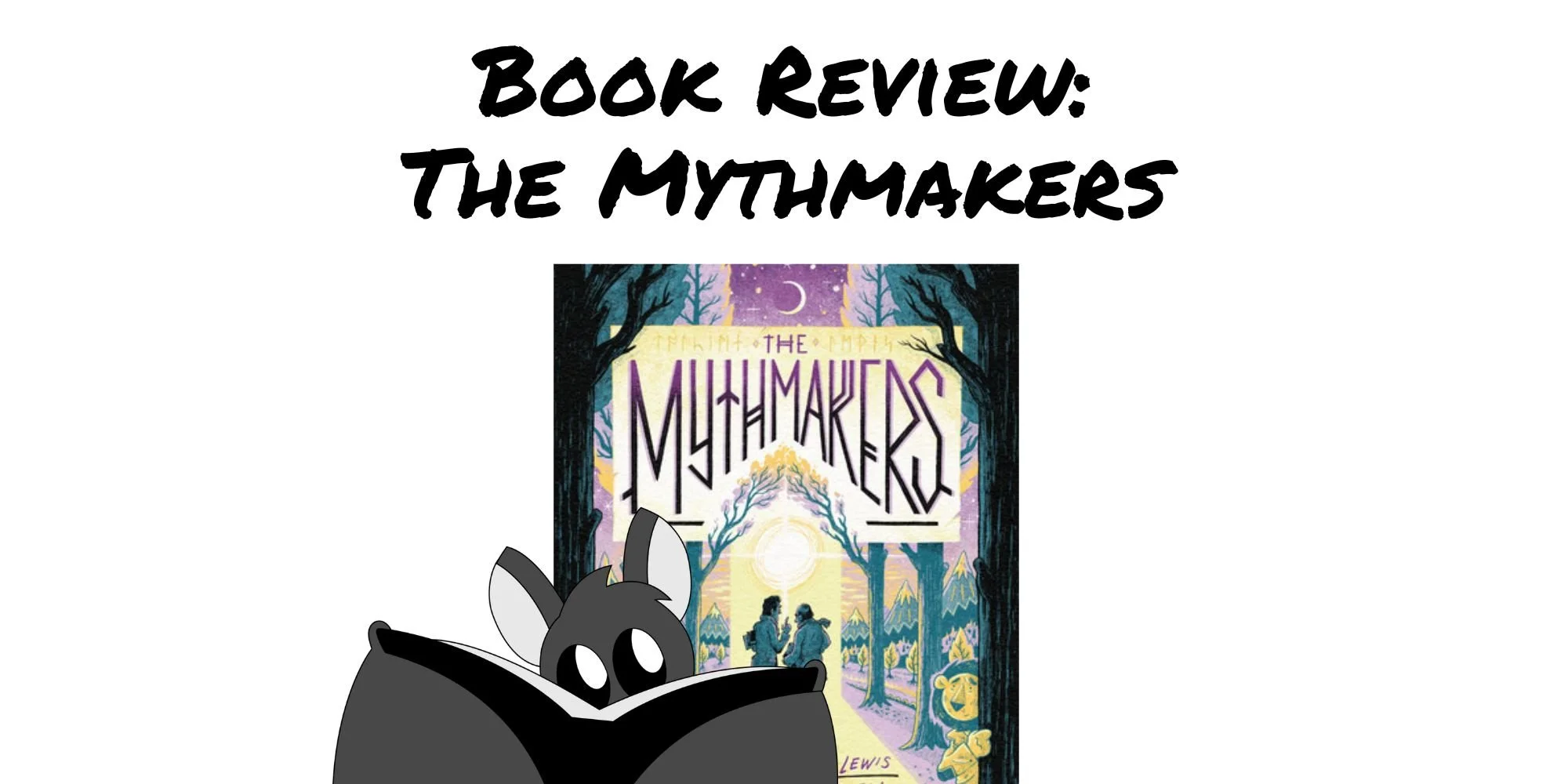
In the latter stages of my research for To Narnia and Beyond, I encountered frequent praise for The Mythmakers: The Remarkable Fellowship of C. S. Lewis and J. R. R. Tolkien. Created by illustrator and writer John Hendrix, and released in 2024, the book meshes elements of graphic novel with illustrations-alongside-prose.

Eventually, I was convinced to buy the book and stepped into Hendrix’s immersive biography of Lewis and Tolkien. Following their lives from birth to death, The Mythmakers gives special attention to their friendship and years shared together. Imaginative narration from a lion and a wizard guides the reader in a fun and informative manner, giving playful context to bunny trails – “Portals” as the book calls them – about the nature of myth and the fantasy genre.

Beautiful, well-researched and poignant, the visuals of The Mythmakers give greater weight and context to the experiences of Lewis and Tolkien. I find it particularly useful for thinking about their time in World War I, where pictures can convey a heaviness that words struggle to speak of.

Whether you are researching Lewis and Tolkien or simply passionate about fantasy and history, I highly recommend this lovingly crafted book. The price tag is a little higher, as it comes in hardcover and full-colour: there is no paperback or black-ink-only edition to provide a cheaper entry point. However, the cost isn’t unreasonable, and I found it well worth the price.

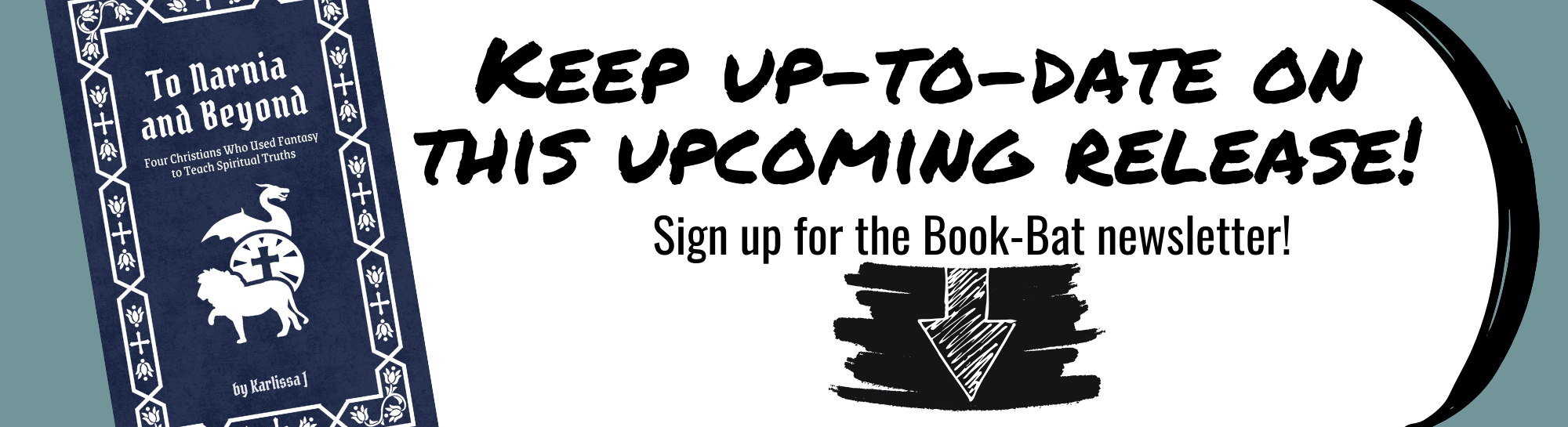
If you’re interested in learning more about the works of C.S. Lewis and J.R.R. Tolkien, you may enjoy my upcoming book, To Narnia and Beyond: Four Christians Who Used Fantasy to Teach Spiritual Truths. Click on the image below to learn more!

January 07, 2026 /Karlissa Koop
The Mythmakers, John Hendrix, book review, books, fantasy genre, fantasy history, Christian fantasy, Chronicles of Narnia, The Lord of the Rings, CS Lewis, JRR Tolkien, classic authors, biography, literary
Book Reviews, Designs and Art, Classic Novels & Authors
Comment

Fantasy Review: Rewriting Adam by Connie Mae Inglis

October 02, 2025 by Karlissa Koop in Book Reviews

Review by Karlissa J

What distance would you travel to finally find a sense of home?

Rewriting Adam by Connie Mae Inglis is the story of a man named Ethan, and how his recent divorce sends him on a quest of soul-searching in Thailand. He doesn’t know how to begin or what to do with himself, but a providential encounter with Janus, and archaeologist, puts him on a path towards facing a ghost, rethinking his past, and setting foot in an alternate, Edenic realm.

From my first read, I was enamoured by the vivid depictions of Thailand and Myanmar. Before the Eden-realm comes into play, we follow Ethan – a Canadian – as he experiences these countries and their cultural differences. When Eden does come into the story, it holds surprises of its own. And there are layers to this novel that stand out the more I’ve read it.

Rewriting Adam generally does a good job of balancing elements of drama, horror, and enchantment. What I would say upon my third reading is that the drama can, in moments, feel overplayed; and the horror aspects could have been more intense and introduced earlier in the novel, considering the important role they play in Ethan’s journey. However, that may be more of my personal preference.

If you expect a fantasy novel to instantly throw you into another world and upon a hero’s quest, the fantastical elements will seem to be introduced too late in the novel. But if you are a lover of sci-fi and fantasy who enjoys stories with more unorthodox pacing, this is a narratively unique and spiritually thoughtful journey worth taking.

October 02, 2025 /Karlissa Koop
review, books, book review, Christian fantasy
Book Reviews
Comment

Four Approaches to Writing Christian Fantasy

June 02, 2025 by Karlissa Koop in Thoughts on Fantasy, Author Insights

By Karlissa J

“If a writer’s aim be logical conviction, he must spare no logical pains… where his object is to move by suggestion, to cause to imagine… If there be music in my reader, I would gladly wake it.” George MacDonald, “The Fantastic Imagination”


Many people debate over whether The Lord of the Rings should be called a “Christian” book series. Tolkien himself once said his books were religious, but different people have different standards for applying the label “Christian” to a work of art; and The Lord of the Rings is subtle in its use of spiritual themes.

For some readers, the subtlety leaves them more open to learning from the books, and the lessons go deeper. Other readers, however, walk away unsure whether they learned anything, and completely unaware of Tolkien’s Christian faith.

Contrast that with the style of George MacDonald. MacDonald was a preacher, and when he told stories he didn’t stop preaching. His fantasy books and fairytales were also deeply symbolic, so in addition to surface-level teachings there are layers to discover upon rereading.

For some (like Lewis) this makes MacDonald’s fantasies rich, exciting, and memorable. Tolkien, however, came to resent them as being too preachy; and some modern readers will find MacDonald’s florid narrative style and layered symbolism hard to make sense of.

L'Engle’s Time Quartet books are an odd mix of openly Christian and bizarrely unconventional. Some readers are deeply moved and drawn to Jesus by these stories, while other readers come away critiquing her beliefs as unorthodox.

And then there’s Lewis. His Cosmic Trilogy alone is all over the place, from only subtly Christian (Out of the Silent Planet) to deeply theological (Perelandra) to focused on critiquing a particular philosophy (That Hideous Strength). His preachiness varies accordingly.

Which is better: to openly declare a Christian message? To subtly explore a Christian worldview in a tale of good versus evil? To fill a story with much teaching and instruction?

I believe all have their place, because there are a myriad of readers in different stages of their walk with God, coming from a variety of backgrounds, ages, reading skills, and learning styles.

In response to a question about how to include Christian messages in a fantasy book, current fantasy author Wayne Thomas Batson had this to say:

“Your allegory will always be too obvious for some and not enough for others. The big thing is, always respect the story itself. If the message within the allegory is precious and valuable, but the story built around it is superficial, it will fail. Tell a fantastic and meaningful story; respect the genre and the reader, and any allegory within will be that much more powerful.” {See Note}

Each of these four classic authors – George MacDonald, J.R.R. Tolkien, C.S. Lewis, and Madeleine L’Engle – had a different way of telling a fantasy story. I encourage you to try reading a book from all of them! Find out which author or authors you enjoy most and learn from best.


NOTE: quote from GoodReads author page for Wayne Thomas Batson: https://www.goodreads.com/author/33508.Wayne_Thomas_Batson/questions (accessed August 27, 2024)

June 02, 2025 /Karlissa Koop
Christian fantasy, classics, classic authors, CS Lewis, JRR Tolkien, George MacDonald, Madeleine L'Engle, writing, tips
Thoughts on Fantasy, Author Insights
Comment

30 Episodes Later!

June 03, 2024 by Karlissa Koop in Thoughts on Fantasy

The Book-Bat podcast has reached 30 episodes, with the latest being a bonus episode announcing the release of Davy Jones’ Aquarium!

Jason and Karlissa have been discussing Christian fantasy books and the wider fantasy landscape, from maturity in fantasy, to why they love fantasy, and their favourite fantasy characters.

Karlissa taught Jason ten fun facts about classic authors CS Lewis, JRR Tolkien, and George MacDonald.

And Jason brought to the table some of his musings and questions. What are the pros and cons of the Christian fantasy market? Which is better: aspirational characters or relatable characters? Have we lost the magic of friendship stories?

Also: “Words matter, people!” What are Mary Sue characters, and where did that term come from?

Many conversations have been planned for the future, so be sure to subscribe to the Book-Bat podcast on Apple Podcasts (iTunes) or Spotify to follow along!

Do you have any topics, books, authors, or shows you’d like to hear discussed? Write a comment on this blog post, or on one of our podcast episodes, or email us at connect@book-bat.com! We’d love to hear from you!

June 03, 2024 /Karlissa Koop
podcast, fantasy genre, Christian fantasy, character development, books, fiction, classics, CS Lewis, George MacDonald, JRR Tolkien, Davy Jones' Aquarium
Thoughts on Fantasy
Comment

Our Podcast!

July 20, 2023 by Karlissa Koop in Sneak Peaks

Want to hear some fun conversations about all things fantasy books? Listen to the Book-Bat podcast, here to help you navigate the world of Christian fantasy!

Since February 2023, Jason and I have been releasing podcast episodes the second and fourth Thursday of each month. Our focus is Christian fantasy books, though we also discuss fantasy in general. Each episode is approximately between 10 and 40 minutes long. Recently, we reached an early milestone in posting our tenth episode!

We began by introducing ourselves and our definition of Christian fantasy.

Twice we’ve done episodes about Christian authors from history: one on CS Lewis, author of the popular Narnia series; and one on George MacDonald, an early pioneer of the fantasy genre.

Other educational episodes include a discussion on manga and graphic novels, and one about the origins of popular fantasy creatures.

We’ve given tips on where to find fantasy and which underrated books are worth reading. And we’ve talked about magic in fantasy, and answered random questions from a jar in parts one and two.

We’re always on the lookout for more topics to discuss; so feel free to send us your questions about fantasy, or recommend books and conversation starters!

July 20, 2023 /Karlissa Koop
podcast, fantasy genre, Christian fantasy
Sneak Peaks
Comment
  • Newer
  • Older

Powered by Squarespace